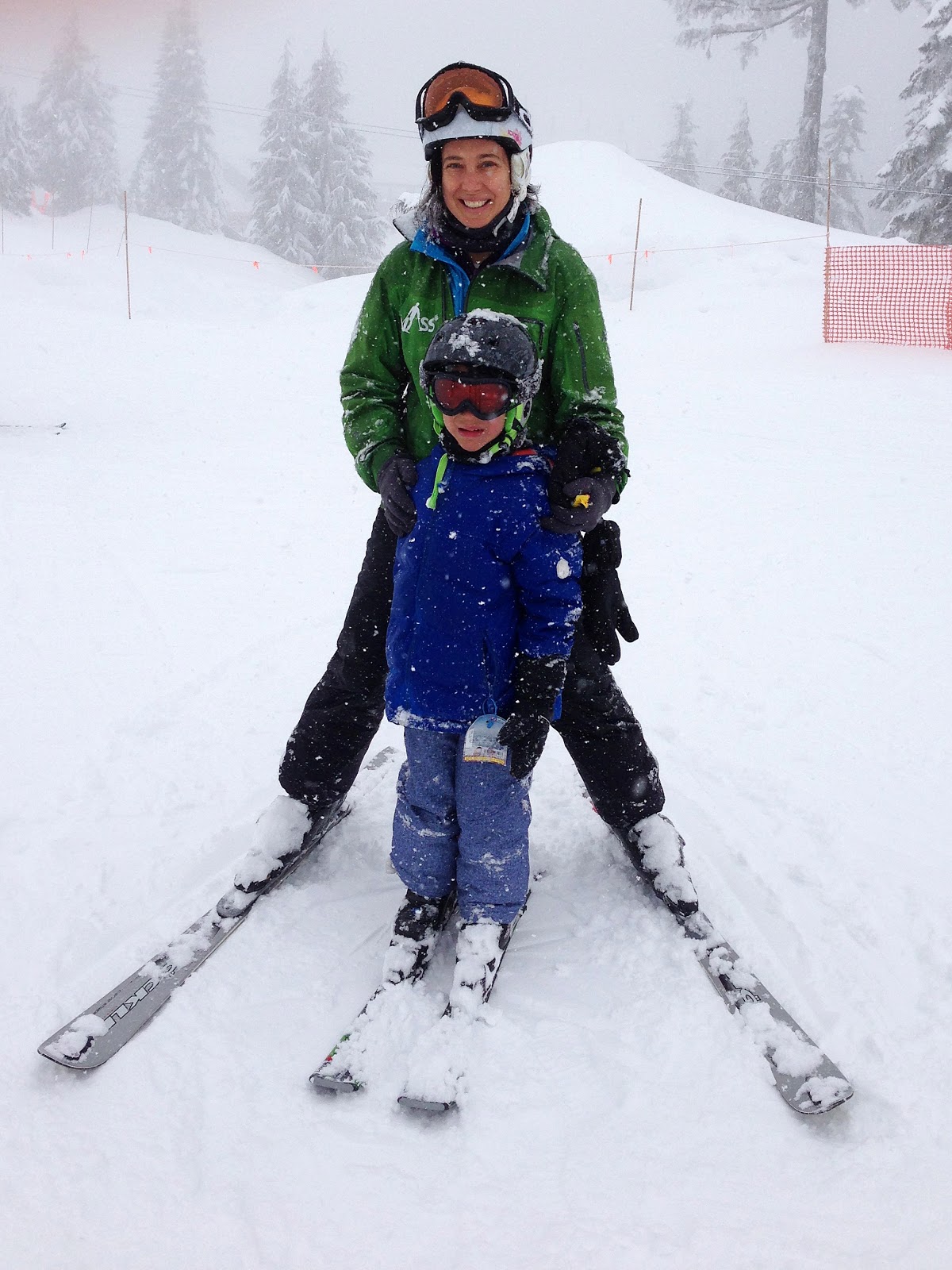
This winter I volunteered as a ski instructor for
Vancouver Adaptive Snow Sports (VASS). Last December, I attended the 3-day training session on Grouse Mountain where we got familiarized with the teaching methodology as well as the use of different adaptive equipment depending on the needs and abilities of students. The sessions covered teaching visually impaired skiers, 3-track and 4-track skiers as well as sit skiers.
 |
| VASS yurt |
A 4-tracker would be a student with little strength in the lower body (e.g. cerebral palsy) who uses outriggers, a sort of crutches with little skies at the bottom, hence the name 4-track. Unlike in regular skiing the turn is initiated by upper body rotation (head, shoulder and arms) and the legs just follow like the trailer of a truck.
A 3-tracker would be an amputee who uses outriggers to balance, however, the technic is pretty much the same as for a regular skier.
A visually impaired student would have little to no eye sight and teaching a visually impaired student is very hands on as we can't show them what to do. During our training session, we practiced skiing with our eyes closed and relying on a fellow instructor to give us directions. It was very awkward as one has to rely entirely on another person and the sense of moving and balance is very different.
Sit skiing is for people who have little or no mobility in their lower body. Depending on the student, a mono-ski or bi-ski can be used. The bi-ski has two skis, is lower and is easier to learn.
At the end of the training session, all of us received the Canadian Association for Disabled Skiing (CADS) level 1 instructor certification.
 |
| Adaptive equipment |
My regular VASS night was on Tuesday night at Cypress with a group of experienced disabled skiers and I got assigned a regular student with a fellow instructor. My student was a young adult with cognitive and developmental issues who talked non-stop throughout the lesson. It was difficult to keep his attention to skiing especially after we met up with the rest of the group half way through the evening. Towards the end of the season he did make some progress and we had some good laughs with him.
I also did a few drop in lessons on the weekends. One student was a 6-year old autistic boy who gave me a big hug right after I met him and his mother. His mother was surprised as he usually doesn't to that. Another student was a 9-year old boy with Down Syndrome and to keep him motivated throughout the lesson we were playing Zombies.
I also got the opportunity to teach a blind Japanese student who at the end of the 2-hour lesson was able to link turns on the bunny slope. That was so inspiring!
Another student I was assisting with is a 12-year old girl a.k.a speed demon, she had to be kept on tethers as her idea of skiing is going straight down the mountain as fast as possible without turning. We were playing catch me if you can by making wide turns across the hill.
In addition to teaching skiing I have made some wonderful friends through VASS including my two ski buddies Angie, a 4-track skier and Anya, a sit-skier. We would go skiing together outside of the VASS program and have lots of fun. These two women are so inspiring as they enjoy life to it's fullest and don't let their disability get in their way.
 |
| Skiing Mount Baker |
VASS also offered ski lessons for instructors and I signed up to take my CADS level 2 exam at the end of this winter season. Part of the exam was to demonstrate 3-tracking and 4-tracking which is not as easy as it sounds as it requires a lot of upper body strength. While I was in Sun Peaks at the end of March, I managed to take part in the CADS level 2 exam there and passed it. I also got my Canadian Ski Instructor Association level 1 certification earlier in March so I am all set for next year's ski season.
The experience with VASS has been very inspiring and rewarding, there are really no words to describe it.